 Add to Chrome
 Add to Firefox
 Add to Edge
UltraLogic: Enhancing LLM Reasoning through Large-Scale Data Synthesis and Bipolar Float Reward
Jan 06, 2026
While Large Language Models (LLMs) have demonstrated significant potential in natural language processing , complex general-purpose reasoning requiring multi-step logic, planning, and verification remains a critical bottleneck. Although Reinforcement Learning with Verifiable Rewards (RLVR) has succeeded in specific domains , the field lacks large-scale, high-quality, and difficulty-calibrated data for general reasoning. To address this, we propose UltraLogic, a framework that decouples the logical core of a problem from its natural language expression through a Code-based Solving methodology to automate high-quality data production. The framework comprises hundreds of unique task types and an automated calibration pipeline across ten difficulty levels. Furthermore, to mitigate binary reward sparsity and the Non-negative Reward Trap, we introduce the Bipolar Float Reward (BFR) mechanism, utilizing graded penalties to effectively distinguish perfect responses from those with logical flaws. Our experiments demonstrate that task diversity is the primary driver for reasoning enhancement , and that BFR, combined with a difficulty matching strategy, significantly improves training efficiency, guiding models toward global logical optima.

EternalMath: A Living Benchmark of Frontier Mathematics that Evolves with Human Discovery
Jan 04, 2026Current evaluations of mathematical reasoning in large language models (LLMs) are dominated by static benchmarks, either derived from competition-style problems or curated through costly expert effort, resulting in limited coverage of research-level mathematics and rapid performance saturation. We propose a fully automated, theorem-grounded pipeline for evaluating frontier mathematical reasoning, which directly transforms recent peer-reviewed mathematical literature into executable and verifiable reasoning tasks. The pipeline identifies constructive or quantitative results, instantiates them into parameterized problem templates, and generates deterministic solutions through execution-based verification, enabling scalable, reproducible, and continuously updatable evaluation without reliance on large-scale expert authoring. By design, this approach supports temporal extensibility, intrinsic correctness checking, and domain-specific customization across mathematical subfields. Applying this pipeline yields \textbf{EternalMath}, an evolving evaluation suite derived from contemporary research papers. Experiments with state-of-the-art LLMs reveal substantial performance gaps, indicating that mathematical reasoning at the research frontier remains far from saturated and underscoring the need for evaluation methodologies that evolve in step with human mathematical discovery.
HY-Motion 1.0: Scaling Flow Matching Models for Text-To-Motion Generation
Dec 29, 2025We present HY-Motion 1.0, a series of state-of-the-art, large-scale, motion generation models capable of generating 3D human motions from textual descriptions. HY-Motion 1.0 represents the first successful attempt to scale up Diffusion Transformer (DiT)-based flow matching models to the billion-parameter scale within the motion generation domain, delivering instruction-following capabilities that significantly outperform current open-source benchmarks. Uniquely, we introduce a comprehensive, full-stage training paradigm -- including large-scale pretraining on over 3,000 hours of motion data, high-quality fine-tuning on 400 hours of curated data, and reinforcement learning from both human feedback and reward models -- to ensure precise alignment with the text instruction and high motion quality. This framework is supported by our meticulous data processing pipeline, which performs rigorous motion cleaning and captioning. Consequently, our model achieves the most extensive coverage, spanning over 200 motion categories across 6 major classes. We release HY-Motion 1.0 to the open-source community to foster future research and accelerate the transition of 3D human motion generation models towards commercial maturity.
OPV: Outcome-based Process Verifier for Efficient Long Chain-of-Thought Verification
Dec 11, 2025Large language models (LLMs) have achieved significant progress in solving complex reasoning tasks by Reinforcement Learning with Verifiable Rewards (RLVR). This advancement is also inseparable from the oversight automated by reliable verifiers. However, current outcome-based verifiers (OVs) are unable to inspect the unreliable intermediate steps in the long reasoning chains of thought (CoTs). Meanwhile, current process-based verifiers (PVs) have difficulties in reliably detecting errors in the complex long CoTs, limited by the scarcity of high-quality annotations due to the prohibitive costs of human annotations. Therefore, we propose the Outcome-based Process Verifier (OPV), which verifies the rationale process of summarized outcomes from long CoTs to achieve both accurate and efficient verification and enable large-scale annotation. To empower the proposed verifier, we adopt an iterative active learning framework with expert annotations to progressively improve the verification capability of OPV with fewer annotation costs. Specifically, in each iteration, the most uncertain cases of the current best OPV are annotated and then subsequently used to train a new OPV through Rejection Fine-Tuning (RFT) and RLVR for the next round. Extensive experiments demonstrate OPV's superior performance and broad applicability. It achieves new state-of-the-art results on our held-out OPV-Bench, outperforming much larger open-source models such as Qwen3-Max-Preview with an F1 score of 83.1 compared to 76.3. Furthermore, OPV effectively detects false positives within synthetic dataset, closely align with expert assessment. When collaborating with policy models, OPV consistently yields performance gains, e.g., raising the accuracy of DeepSeek-R1-Distill-Qwen-32B from 55.2% to 73.3% on AIME2025 as the compute budget scales.
ATLAS: A High-Difficulty, Multidisciplinary Benchmark for Frontier Scientific Reasoning
Nov 18, 2025The rapid advancement of Large Language Models (LLMs) has led to performance saturation on many established benchmarks, questioning their ability to distinguish frontier models. Concurrently, existing high-difficulty benchmarks often suffer from narrow disciplinary focus, oversimplified answer formats, and vulnerability to data contamination, creating a fidelity gap with real-world scientific inquiry. To address these challenges, we introduce ATLAS (AGI-Oriented Testbed for Logical Application in Science), a large-scale, high-difficulty, and cross-disciplinary evaluation suite composed of approximately 800 original problems. Developed by domain experts (PhD-level and above), ATLAS spans seven core scientific fields: mathematics, physics, chemistry, biology, computer science, earth science, and materials science. Its key features include: (1) High Originality and Contamination Resistance, with all questions newly created or substantially adapted to prevent test data leakage; (2) Cross-Disciplinary Focus, designed to assess models' ability to integrate knowledge and reason across scientific domains; (3) High-Fidelity Answers, prioritizing complex, open-ended answers involving multi-step reasoning and LaTeX-formatted expressions over simple multiple-choice questions; and (4) Rigorous Quality Control, employing a multi-stage process of expert peer review and adversarial testing to ensure question difficulty, scientific value, and correctness. We also propose a robust evaluation paradigm using a panel of LLM judges for automated, nuanced assessment of complex answers. Preliminary results on leading models demonstrate ATLAS's effectiveness in differentiating their advanced scientific reasoning capabilities. We plan to develop ATLAS into a long-term, open, community-driven platform to provide a reliable "ruler" for progress toward Artificial General Intelligence.
Spatial-SSRL: Enhancing Spatial Understanding via Self-Supervised Reinforcement Learning
Oct 31, 2025Spatial understanding remains a weakness of Large Vision-Language Models (LVLMs). Existing supervised fine-tuning (SFT) and recent reinforcement learning with verifiable rewards (RLVR) pipelines depend on costly supervision, specialized tools, or constrained environments that limit scale. We introduce Spatial-SSRL, a self-supervised RL paradigm that derives verifiable signals directly from ordinary RGB or RGB-D images. Spatial-SSRL automatically formulates five pretext tasks that capture 2D and 3D spatial structure: shuffled patch reordering, flipped patch recognition, cropped patch inpainting, regional depth ordering, and relative 3D position prediction. These tasks provide ground-truth answers that are easy to verify and require no human or LVLM annotation. Training on our tasks substantially improves spatial reasoning while preserving general visual capabilities. On seven spatial understanding benchmarks in both image and video settings, Spatial-SSRL delivers average accuracy gains of 4.63% (3B) and 3.89% (7B) over the Qwen2.5-VL baselines. Our results show that simple, intrinsic supervision enables RLVR at scale and provides a practical route to stronger spatial intelligence in LVLMs.
Hunyuan3D Studio: End-to-End AI Pipeline for Game-Ready 3D Asset Generation
Sep 16, 2025
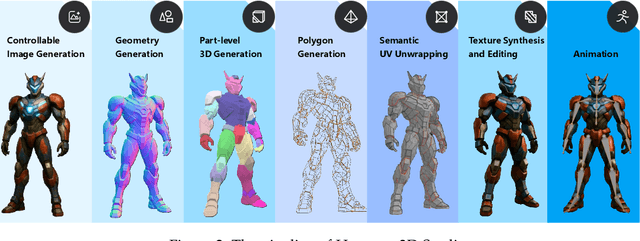

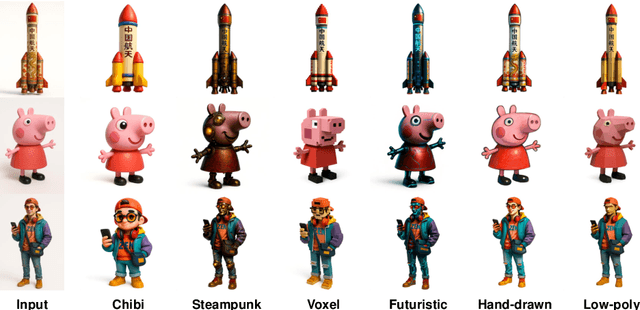
The creation of high-quality 3D assets, a cornerstone of modern game development, has long been characterized by labor-intensive and specialized workflows. This paper presents Hunyuan3D Studio, an end-to-end AI-powered content creation platform designed to revolutionize the game production pipeline by automating and streamlining the generation of game-ready 3D assets. At its core, Hunyuan3D Studio integrates a suite of advanced neural modules (such as Part-level 3D Generation, Polygon Generation, Semantic UV, etc.) into a cohesive and user-friendly system. This unified framework allows for the rapid transformation of a single concept image or textual description into a fully-realized, production-quality 3D model complete with optimized geometry and high-fidelity PBR textures. We demonstrate that assets generated by Hunyuan3D Studio are not only visually compelling but also adhere to the stringent technical requirements of contemporary game engines, significantly reducing iteration time and lowering the barrier to entry for 3D content creation. By providing a seamless bridge from creative intent to technical asset, Hunyuan3D Studio represents a significant leap forward for AI-assisted workflows in game development and interactive media.
HunyuanWorld 1.0: Generating Immersive, Explorable, and Interactive 3D Worlds from Words or Pixels
Jul 29, 2025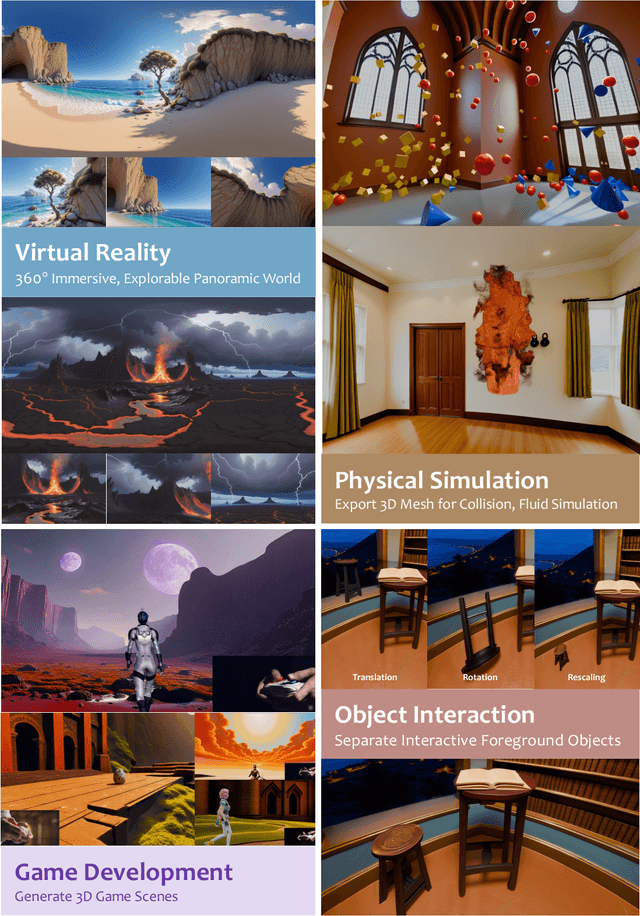

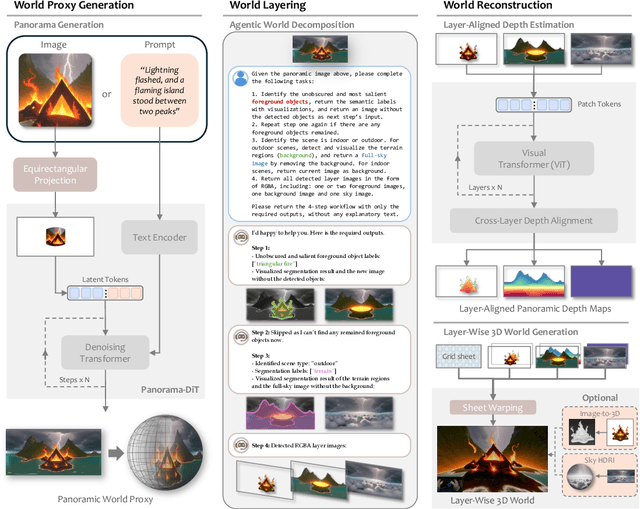
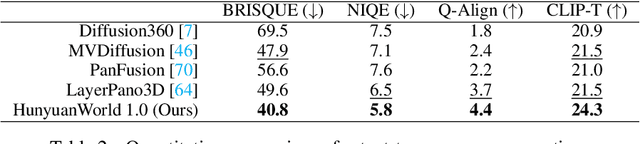
Creating immersive and playable 3D worlds from texts or images remains a fundamental challenge in computer vision and graphics. Existing world generation approaches typically fall into two categories: video-based methods that offer rich diversity but lack 3D consistency and rendering efficiency, and 3D-based methods that provide geometric consistency but struggle with limited training data and memory-inefficient representations. To address these limitations, we present HunyuanWorld 1.0, a novel framework that combines the best of both worlds for generating immersive, explorable, and interactive 3D scenes from text and image conditions. Our approach features three key advantages: 1) 360{\deg} immersive experiences via panoramic world proxies; 2) mesh export capabilities for seamless compatibility with existing computer graphics pipelines; 3) disentangled object representations for augmented interactivity. The core of our framework is a semantically layered 3D mesh representation that leverages panoramic images as 360{\deg} world proxies for semantic-aware world decomposition and reconstruction, enabling the generation of diverse 3D worlds. Extensive experiments demonstrate that our method achieves state-of-the-art performance in generating coherent, explorable, and interactive 3D worlds while enabling versatile applications in virtual reality, physical simulation, game development, and interactive content creation.
Privacy-Preserving Synthetic Review Generation with Diverse Writing Styles Using LLMs
Jul 24, 2025The increasing use of synthetic data generated by Large Language Models (LLMs) presents both opportunities and challenges in data-driven applications. While synthetic data provides a cost-effective, scalable alternative to real-world data to facilitate model training, its diversity and privacy risks remain underexplored. Focusing on text-based synthetic data, we propose a comprehensive set of metrics to quantitatively assess the diversity (i.e., linguistic expression, sentiment, and user perspective), and privacy (i.e., re-identification risk and stylistic outliers) of synthetic datasets generated by several state-of-the-art LLMs. Experiment results reveal significant limitations in LLMs' capabilities in generating diverse and privacy-preserving synthetic data. Guided by the evaluation results, a prompt-based approach is proposed to enhance the diversity of synthetic reviews while preserving reviewer privacy.
Hunyuan3D 2.1: From Images to High-Fidelity 3D Assets with Production-Ready PBR Material
Jun 18, 20253D AI-generated content (AIGC) is a passionate field that has significantly accelerated the creation of 3D models in gaming, film, and design. Despite the development of several groundbreaking models that have revolutionized 3D generation, the field remains largely accessible only to researchers, developers, and designers due to the complexities involved in collecting, processing, and training 3D models. To address these challenges, we introduce Hunyuan3D 2.1 as a case study in this tutorial. This tutorial offers a comprehensive, step-by-step guide on processing 3D data, training a 3D generative model, and evaluating its performance using Hunyuan3D 2.1, an advanced system for producing high-resolution, textured 3D assets. The system comprises two core components: the Hunyuan3D-DiT for shape generation and the Hunyuan3D-Paint for texture synthesis. We will explore the entire workflow, including data preparation, model architecture, training strategies, evaluation metrics, and deployment. By the conclusion of this tutorial, you will have the knowledge to finetune or develop a robust 3D generative model suitable for applications in gaming, virtual reality, and industrial design.